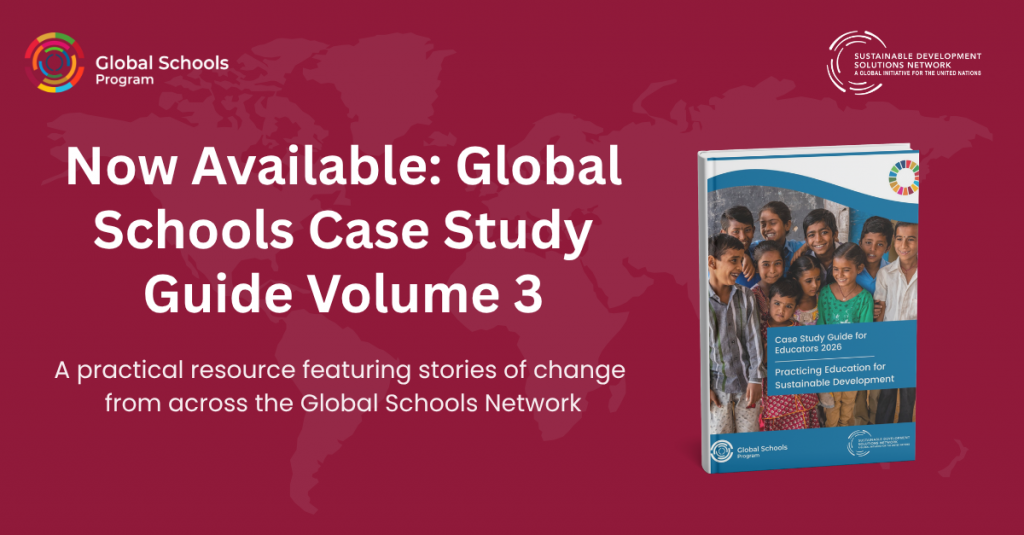
Centro Studi Casnati has been selected by the Global Schools Program of the United Nations Sustainable Development Solutions Network (UN SDSN) as one of the international case studies featured in the publication Practicing Education for Sustainable Development: Case Study Guide for Educators – Volume 3.
Presented on 24 April 2026 on the occasion of the United Nations International Day of Multilateralism and Diplomacy for Peace, the publication brings together around thirty experiences developed by Global Schools Advocate Alumni from different countries around the world. It serves as a resource for school leaders, educators, and policymakers interested in integrating Education for Sustainable Development (ESD) into education systems.
The guide documents different levels of curricular integration of ESD by collecting experiences, implementation strategies, educational activities, organisational approaches, and key lessons learned across different educational contexts, intending to provide concrete and adaptable examples for primary and secondary schools.
The case study dedicated to Centro Studi Casnati, entitled A Scalable Model for Integrating Sustainability into Education, documents the pathway developed through Casnati for ESD, describing the evolution of a scalable educational model established in 2022 through collaboration with the Global Schools Program and progressively integrated into teaching, school organisation, and relationships with the local community.
From Educational Initiatives to an Educational Ecosystem
One of the defining features of the case study is the transition from an approach based on the implementation of individual projects to a systemic model in which Education for Sustainable Development becomes an integral part of the school’s everyday functioning.
As illustrated during the international launch event, the pathway developed by Centro Studi Casnati is based on three synergistic elements:
- integration, through the cross-curricular involvement of different study programmes in shared educational processes;
- real-world learning environments, in which students work within services, events, and activities that are already part of school life;
- structured partnerships, developed over time with institutions, universities, businesses, public bodies, and organisations across the local area.
These elements make it possible to transform ESD from a collection of individual projects into a way of operating within Centro Studi Casnati, progressively generating new educational, organisational, and territorial opportunities.
Within this model, every new partnership, activity, or project is not regarded as an isolated initiative, but rather as a contribution to strengthening an educational ecosystem in which teaching, school organisation, community engagement, and international development continuously reinforce one another, increasing the overall value of the system over time.
A Model Connected to Local Communities and International Networks
The case study also highlights how internationalisation is not treated as a separate objective, but rather as a natural consequence of the educational model and of the school’s ability to build collaborative networks at local, national, and international levels.
Over the past few years, Casnati for ESD has developed a network of more than fifty stakeholders, including institutions, universities, businesses, associations, and local and international organisations, supporting the development of interdisciplinary learning pathways, shared events, and learning opportunities in authentic contexts.
This network represents one of the factors that has enabled the model to evolve, integrating into Centro Studi Casnati’s educational offer alongside other international frameworks such as Cambridge IGCSE, GreenComp, and DigComp, while maintaining a unified vision of transformative education and the Mission 4.7 at its core.
From this perspective, internationalisation emerges as a process capable of generating shared value among the school, the local community, and international networks.

The International Launch of the Guide
To mark the publication of the guide, the Global Schools Program organised an international webinar during which several case study authors presented their experiences and strategies for integrating Education for Sustainable Development into different education systems.
Centro Studi Casnati was also invited to contribute to the event, presenting its own experience alongside other Global Schools Advocates and taking part in the concluding panel discussion dedicated to the development of educational models for sustainability.
The event provided an important opportunity for dialogue among practices sharing the common objective of integrating Education for Sustainable Development into education systems while promoting structural change within schools.
Further Reading:
- Case Study Guide – Volume 3:
https://www.globalschoolsprogram.org/_files/ugd/3e188d_6aebacdb2df8416fbb2a97e26d70eb4b.pdf - Global Schools Program press release announcing the launch of the guide:
https://www.globalschoolsprogram.org/post/global-schools-program-launches-case-study-guidebook-on-international-day-of-multilateralism-and-dip - Regeneration Forum 2025 – “Why the Casnati for ESD Project Has Become a Regeneration Model”:
https://esd.centrocasnati.it/2026/01/18/portfolio-perche-il-progetto-casnati-for-esd-e-diventato-un-modello-di-rigenerazione/ - ESD Territorial Manifesto developed during the conference Education and Sustainable Development: Building Territorial Networks to Create Value (5 November 2024):
https://drive.google.com/file/d/1p5Tgs0OVdV9zU5O-76bLt1tEwpHXd1li/view
#CasnatiforESD #wearecasnati